


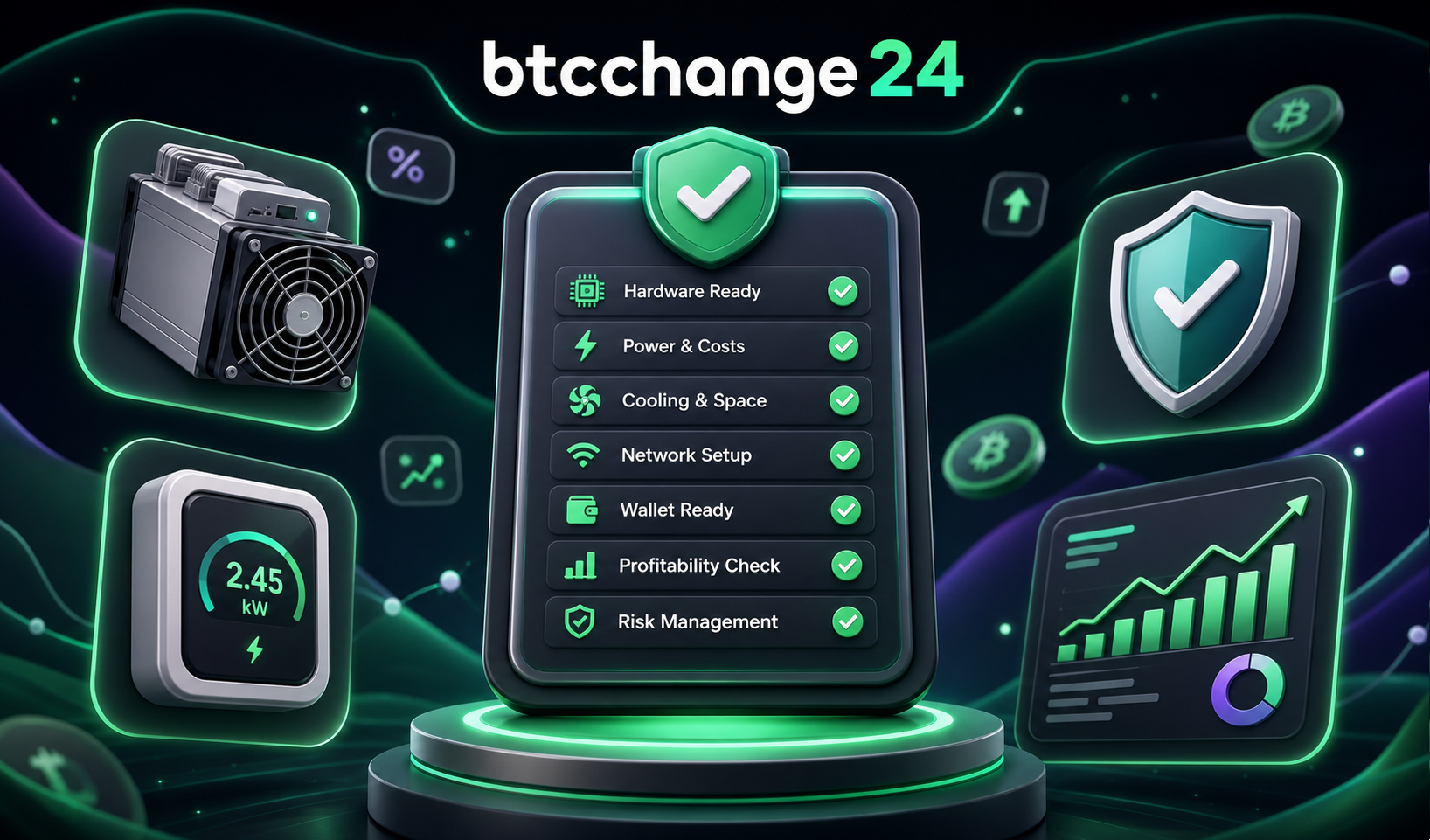
Cryptocurrency mining looks simple from the outside: buy hardware, plug it in, and receive coins. In reality, a beginner first has to deal with electricity costs, heat, noise, mining pool rules, maintenance, taxes, wallet security, and the risk of buying equipment that never pays for itself. Before you start, check the whole route from the wall socket to the final use of mined coins.
Start with the economics, not the machine
The main question is not which coin is popular today, but how much every hour of operation costs in your location. Market guides for 2026 point to the same core variables: electricity price, hardware efficiency, network difficulty, and coin price. Residential power can erase most of the margin, especially for older hardware.
Practical example. A miner can show positive gross revenue while producing little or no net profit after electricity, cooling, downtime, and repairs. Always calculate net result, not just expected revenue.
- know your exact electricity price per kWh;
- convert device power draw into monthly operating cost;
- assume network difficulty can rise;
- do not treat future coin price growth as guaranteed;
- include ventilation, cables, breakers, maintenance, and downtime.
Check the mining type: ASIC, GPU, or CPU
Mining is not one universal activity. Bitcoin mining requires specialized ASICs. Some alternative coins can be mined with GPUs or CPUs, but competition and profitability change quickly. Buying graphics cards without a calculation can become an expensive experiment rather than an investment.
Method limitation. ASICs are efficient for one algorithm but usually useless outside it. GPUs are more flexible, but weaker where specialized hardware dominates. CPU mining is accessible, yet rarely meaningful without a specific setup.
Beginner pre-purchase checklist
Check | Why it matters | Risk if ignored |
|---|---|---|
Electricity price | The main recurring cost. | The machine runs at a loss. |
Hardware efficiency | Power per unit of hashrate matters more than headline output. | A cheap used miner becomes expensive to operate. |
Noise and heat | ASICs may be unsuitable for an apartment. | Overheating, complaints, or forced shutdowns. |
Pool payouts | Minimum payouts, fees, and stability affect cash flow. | Earnings are delayed or reduced. |
Wallet and network | You need a safe destination for mined coins. | Wrong address, lost seed, or extra fees. |
Legal and tax context | Rules vary by jurisdiction. | Reporting or banking problems later. |
Electricity, cooling, and safety
Mining hardware runs under constant load. Do not connect several high-power devices to a random extension cord. You need proper wiring, breaker capacity, ventilation, temperature monitoring, and fire-safety discipline.
Common mistake. A beginner budgets for the ASIC but not for the room. The machine is purchased, but it cannot be used at home because of heat, noise, and electrical load.
Pool, wallet, and coin handling
Most beginners use mining pools because solo mining is unrealistic for small participants on major networks. Before connecting, review the pool's reputation, payout method, minimum withdrawal, fee model, and supported addresses. Then secure a wallet that supports the exact asset and network.
Do not send payouts to an address you do not control. If you plan to sell mined coins later, think about the exchange route in advance, but do not build the mining decision on hopes about future market price.
How to estimate payback without self-deception
Payback is a scenario, not a promise. Include hardware, delivery, customs, electricity, cooling, repairs, downtime, network difficulty, and coin price. Calculators are useful snapshots, not a guaranteed one-year forecast.
- Calculate the base case at current market conditions.
- Run a stress case: price drops, difficulty rises, downtime appears.
- Estimate resale value of the hardware.
- Avoid borrowed money if the model only works in an optimistic case.
When a beginner should not start mining
If you do not know your electricity rate, cannot handle heat and noise, do not understand wallet security, and expect passive income, pause the plan. It may be better to learn wallets, networks, and basic crypto safety first.
Answers to common questions
Can I mine Bitcoin at home in 2026?
Technically yes, but it is often weak economically. You need efficient ASIC hardware, low-cost power, proper ventilation, and a conservative cost model.
Is ASIC price or efficiency more important?
Efficiency is more important for continuous operation. A cheap old unit can consume too much power and lose to newer hardware over time.
Should I buy several miners at once?
A beginner should usually test one complete setup first. Scaling multiplies every mistake in electricity, cooling, pool choice, and maintenance.
Conclusion
Before mining, check the whole infrastructure: power, room, pool, wallet, legal context, exit route, and stress scenarios. If the numbers still work conservatively, testing may make sense. If profit appears only in an ideal spreadsheet, wait.
