


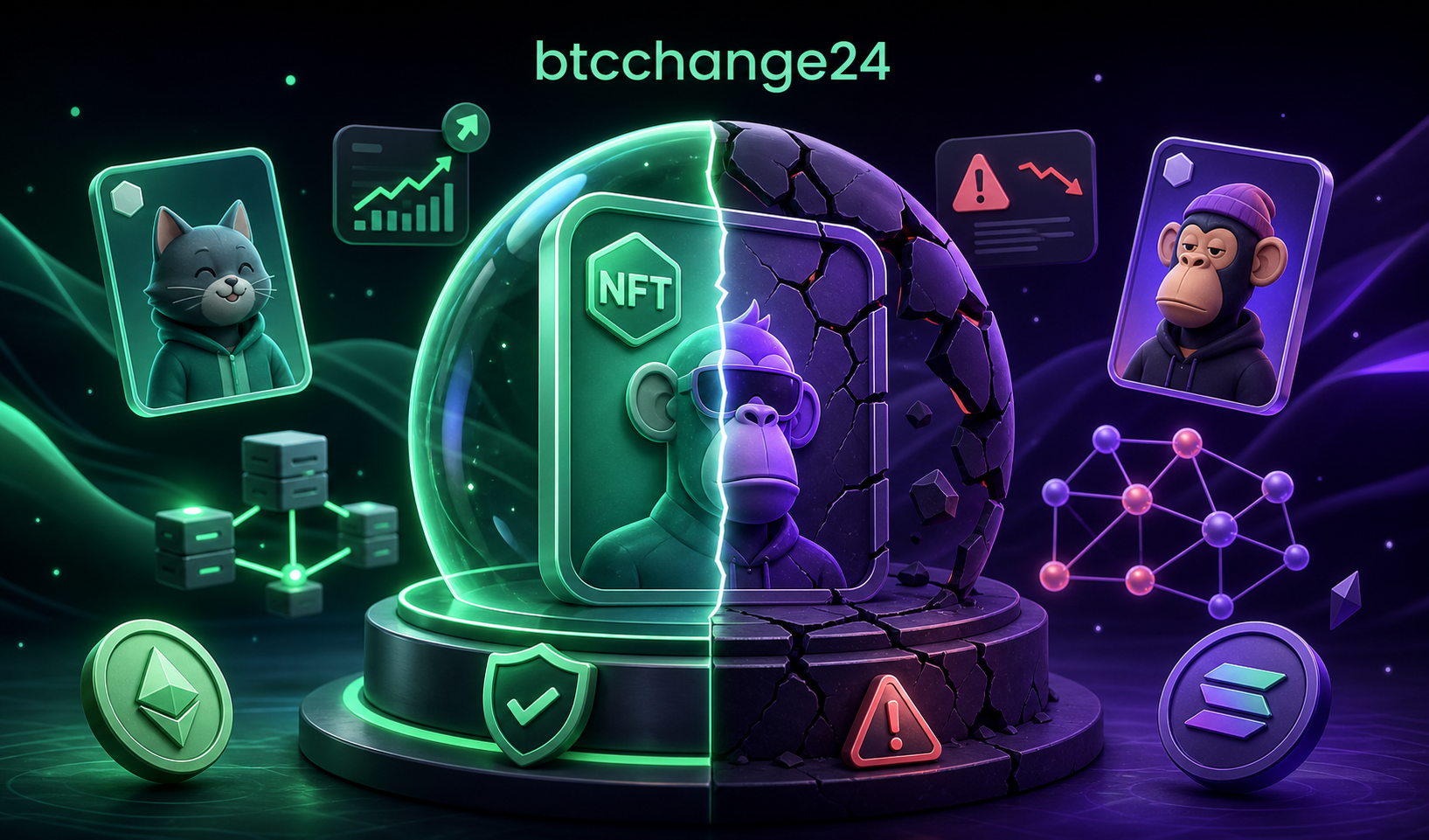
NFTs are no longer only pictures: they can represent access, game items, collections, names, and digital rights inside different ecosystems. Yet user mistakes remain familiar: confusing a marketplace with a wallet, failing to verify a collection, signing dangerous permissions, and not understanding the difference between centralized and decentralized NFT solutions.
Centralized vs decentralized NFT solutions
A centralized platform usually provides more interface, moderation, accounts, and support. It is easier to start, but access partly depends on platform rules. A decentralized solution usually works through a wallet and smart contracts: the user has more control, but also more personal responsibility.
Term explanation. An NFT may be in your wallet, while its image, description, or metadata may be stored elsewhere. That is why the token and the surrounding infrastructure both matter.
Comparison table
Criterion | Centralized solutions | Decentralized solutions |
|---|---|---|
Access | Through an account, platform rules, and interface. | Through a wallet, network, and smart contract. |
Control | Some control belongs to the platform. | More control belongs to the wallet owner. |
Blocking risk | Higher at the account or listing level. | Lower at protocol level, although interfaces may still restrict access. |
User mistakes | Fake collections, accounts, and platform-rule confusion. | Dangerous signatures, approvals, phishing, wrong networks. |
Support | Support may exist, but it cannot always recover assets. | Usually there is no central arbiter. |
Mistake #1: buying without verifying the collection
A common scenario is buying a token from a fake collection because the name, avatar, or link looks similar. Popular collections often have copies, fake mints, and scam pages. Check not only the image, but the contract, official links, activity, and source of the mint or listing.
Common mistake. Treating a badge, polished website, or active chat as an absolute guarantee. These are signals, not full protection.
Mistake #2: signing permissions blindly
To buy, sell, or transfer an NFT, a wallet may request a signature or transaction. A signature does not always mean a transfer, but it can authorize an action. Read what the wallet asks for: listing, transfer, approval, or simple login.
If the interface creates urgency, promises a bonus, or asks for an unclear message signature, stop. NFT scams often do not break the blockchain; they persuade the user to approve the action.
Mistake #3: confusing token ownership with data storage
Owning an NFT in a wallet does not always mean permanent access to the image or external content. Metadata may be stored on a centralized server, IPFS, or another layer. If a project disappears or changes infrastructure, the user may keep the token but lose the expected experience.
Safer NFT practices
- Use a separate wallet for mints and new collections.
- Verify contracts through official sources.
- Do not follow links from direct messages.
- Do not sign actions you do not understand.
- For valuable NFTs, separate cold storage from trading wallets.
- Do not treat centralized marketplaces as a complete safety guarantee.
Frequently asked questions
Is a centralized NFT marketplace safer?
It may be easier to use, but it does not remove fake-collection, phishing, blocking, or user-error risks.
If an NFT is in my wallet, can I still lose it?
Yes. It can be lost through a malicious signature, wrong transfer, or compromised seed phrase. Metadata can also depend on external storage.
Should I revoke NFT approvals?
Yes, especially if the approval is no longer needed or you interacted with a questionable contract.
Conclusion
The core difference is simple: centralized NFT solutions offer more convenience, decentralized ones offer more control. In both cases, users must verify collections, contracts, signatures, and access rules. Without that discipline, convenience quickly turns into risk.
