


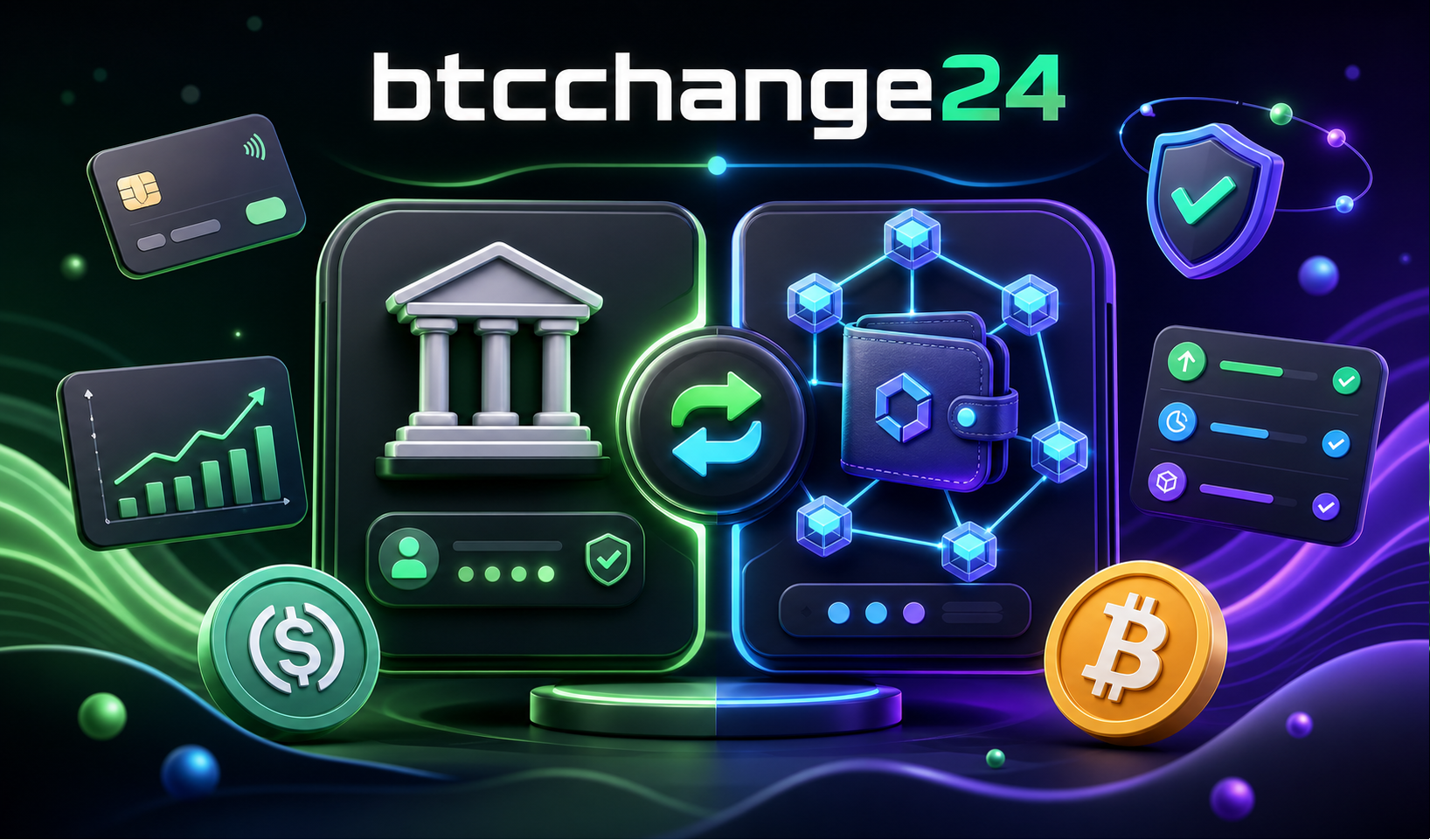
Crypto payments are no longer just a simple transfer from one address to another. The same phrase may describe a custodial gateway, an exchange-based payout, a stablecoin invoice, a non-custodial checkout, a smart contract, or a direct wallet-to-wallet transfer. The useful question is not which model sounds more modern. It is who controls the funds, where the operational risk appears, and whether the route is clear before the payment is sent.
What a centralized crypto payment means in practice
A centralized solution is any payment route with an operator between the sender and the recipient: an exchange, payment gateway, exchanger, processor, or other intermediary. The operator may create an invoice, receive funds to its own address, check the transaction, convert the asset, wait for confirmations, and then release the payout.
The advantage is manageability. Users get an interface, transaction history, statuses, and a support desk. The drawback is dependence on the operator’s rules: checks, processing time, route availability, internal rate, limits, and freezing policies.
Term explained. A custodial scenario means that a third party controls assets or their movement at least at one stage. That is not automatically bad, but it is always a separate risk to evaluate.
What belongs to decentralized payment models
A decentralized crypto payment is built around direct wallet interaction, smart contracts, or protocols where the user signs the transaction and controls the keys. Examples include a transfer from a personal wallet, a non-custodial gateway, a DEX route, an on-chain escrow, or a smart contract with predefined logic.
This model reduces dependence on an operator but increases personal responsibility. If the wrong network is selected, the wrong token is sent, or a malicious contract is approved, recovery is usually difficult. A protocol cannot simply reverse a confirmed transaction because a user asks for it.
The key difference is control, not only fees
Many users compare crypto payments only by network fee or advertised service fee. That is too narrow. The real cost includes network fees, exchange-rate spread, delay risk, rejection risk, the cost of an error, and the time needed to resolve a problem.
Common mistake. A user sees a low fee in the interface but does not check the conversion rate, who holds funds before payout, or what happens during manual review. A route that looks cheap may become expensive because of spread or delay.
Comparison point | Centralized solution | Decentralized solution | What to check first |
|---|---|---|---|
Control of funds | Part of the route is controlled by an operator | The user signs operations directly | Who holds assets and whether cancellation is possible |
Address and network errors | Support may help, but there is no guarantee | Errors are often irreversible | Whether token, network, and address match |
Price transparency | There may be spread, service fee, or internal rate | The route is visible on-chain, but gas and slippage apply | The final amount received, not just the visible fee |
Support | There is a clear contact point | Depends on wallet or protocol | How stuck or mistaken payments are handled |
When a centralized route is more convenient
Centralized solutions often work better when users need a clear interface, support, fiat rails, accounting records, or a simple experience for customers who do not want to manage networks and gas. For a business, it can reduce operational work because invoices and statuses live in one dashboard.
Still, convenience does not replace due diligence. Before using the route, check where funds are held, how many confirmations are required, whether additional review is possible, how the rate is calculated, and what happens if the customer underpays, overpays, or pays from an unexpected address.
When a decentralized route is stronger
Decentralized solutions are stronger when self-custody, on-chain transparency, and reduced intermediary dependence matter. They fit experienced users, technical teams, and projects that need programmable payments through contracts.
Method limitation. Self-custody is not the same as automatic safety. The user must protect the seed phrase, verify addresses, understand token approvals, watch the network, and avoid signing unclear wallet requests.
How to check the route before paying
Start with simple questions: which asset is being sent, on which network, to which address, who receives it, what amount arrives after all costs, and where the status can be tracked. If one answer is unclear, avoid sending a large amount.
- Verify the network: ERC-20, TRC-20, BNB Smart Chain, and other networks are not interchangeable.
- Check that the recipient supports this exact token on this exact network.
- Estimate the final amount including spread, gas, service fee, and possible slippage.
- Use a test transaction when the route is new and the amount is meaningful.
- Save the transaction hash, order number, or other identifier.
Risks that are often underestimated
In centralized routes, users often underestimate delays, manual review, and changing route availability. In decentralized routes, they underestimate wrong-network transfers, phishing interfaces, and harmful token approvals. In both cases, a polished interface is not enough proof of safety.
Expert micro-insight. A good payment route is not described by “fast and cheap”. It is described by conditions: who receives the asset, on which network, how many confirmations are needed, how the final amount is calculated, where status is visible, and what to do if something goes wrong.
Frequently asked questions
Which is safer: centralized or decentralized crypto payments?
Neither model is universally safer. Centralized routes add support and operational control but create intermediary risk. Decentralized routes give more control but make user mistakes harder to reverse.
Can I choose a route only by fee?
No. Compare final amount, rate, spread, network fee, processing time, freezing risk, and support options.
Should I make a test transaction?
For a new route or a large amount, yes. A small test helps verify the network, address, posting speed, and status flow.
Conclusion
Compare crypto payments by the money route and responsibility, not by labels. If you need support and fiat handling, a centralized operator may be easier. If control and on-chain transparency matter more, a decentralized route may be stronger.
The practical rule is simple: verify the network, asset, final amount, processing conditions, and error scenario before sending funds. That is how small technical details stop becoming expensive mistakes.
